
Where to Buy Authentic Vintage Glassware
Table of Contents
- Where to Buy Authentic Vintage Glassware Online
- How to Identify Vintage Glassware Before You Buy
- Most Sought-After Vintage Glassware Types
- Condition Grading and What to Check
- Shipping, Returns, and Buyer Protection
- Price Benchmarks by Glass Type and Era
- Frequently Asked Questions
Last Updated: October 18, 2026
Where to Buy Authentic Vintage Glassware Online
Finding authentic vintage glassware that doesn't require restoration is harder than it looks. The market is flooded with reproductions, damaged pieces passed off as "character," and sellers who don't know what they're selling. This guide covers where to buy authentic vintage glassware, what to check before you commit, and how to avoid common traps.
At Tipsyish, we've spent years sourcing and curating vintage barware, and we know buying vintage online requires understanding condition standards, maker identification, and the sellers who stand behind their inventory.
Curated Collections: Tipsyish
When you want to buy authentic vintage glassware without spending hours vetting sellers, curated collections cut through the noise. At Tipsyish, we focus on pieces that work for entertaining, not just display.
We take responsibility for authenticity, documenting maker's marks, approximate era, condition details, and any limitations upfront, so you're not gambling on an unresearched description.
For example, our Vintage Libbey Silver Leaf Frosted Rocks Glasses ($36.00) are verified Libbey pieces from the mid-century era with the maker's mark intact.

What to Expect Across Different Sellers
Not all vintage sellers operate the same way.
High-volume marketplaces cast a wide net: incredible deals and rare pieces, but also reproductions, damaged items, and sellers who don't understand what they're selling.
Curated shops like Tipsyish sit in the middle: fewer options, but higher confidence. Our Vintage Georges Briard Frosted White Bird Old Fashioned Glasses ($50.00) command that price because they're verified Briard pieces with signature marks intact and exceptional condition.

Specialty antique dealers bring the deepest expertise but often the highest prices. They're worth consulting if you're hunting a specific era or maker, or want expert authentication before a major purchase.
How to Identify Vintage Glassware Before You Buy
Authenticity starts with knowing what to look for: maker's marks, authentic aging, and the red flags of a reproduction.
Spotting Maker's Marks and Signatures
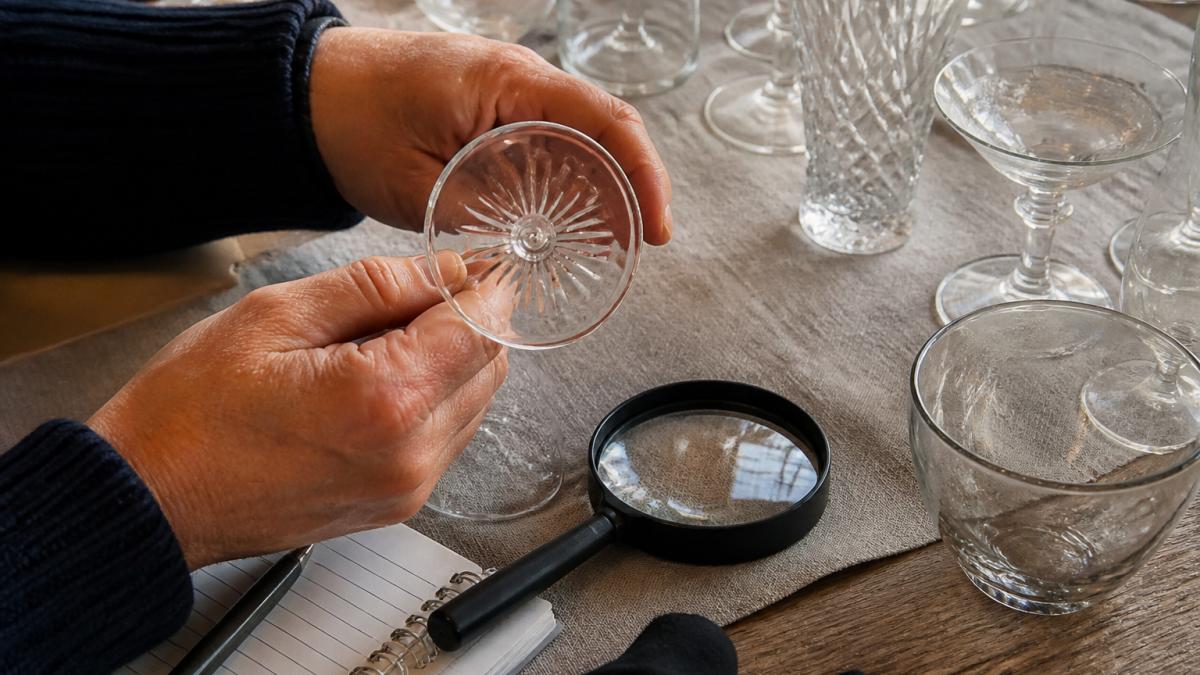
The easiest way to verify authenticity is the maker's mark. Libbey, Georges Briard, Kanawha Glass, and other major manufacturers marked their pieces consistently.
Look on the bottom first.
Check the mark's depth and clarity. Authentic marks have consistent depth; a shallow, uneven mark often signals reproduction. Compare the mark style to documented examples online.
Not all vintage glassware is marked. Unmarked pieces aren't automatically fake, many mid-century manufacturers produced unmarked barware, but they require more detective work. Match the pattern, color, and manufacturing technique to known examples from the era.
Recognizing Authentic Aging and Wear
Authentic vintage glassware shows wear patterns that are nearly impossible to fake. The key is knowing genuine aging versus damage that reduces value.
Authentic aging on frosted glass includes slight clouding or haziness in the frosted band from decades of moisture and handling.
Authentic wear on clear glass includes light, random, shallow surface scratching from washing and use; deep gouges only appear if the glass was dropped.
Red Flags for Reproductions
Reproductions have become more sophisticated, but they still have tells.
Check the glass weight. Authentic mid-century glassware is heavier than modern glass; if a glass feels light and thin, it's likely modern.
Look at the bottom.
Color consistency is another tell. Authentic colored glassware from the 1950s-70s often shows slight variation from piece to piece, while modern reproductions tend to have uniform color from precise temperature control.
Finally, check the pattern edges.
Most Sought-After Vintage Glassware Types
Knowing which types of vintage glassware command attention, and why, helps you recognize value when you see it.
Mid-Century Modern Rocks and Highball Glasses
Mid-century rocks and highball glasses are the most actively collected category of vintage barware, the vessels of 1950s-70s cocktail culture, sought for authenticity, design, and functionality.
The most sought-after rocks glasses feature metallic decorations: gold leaf, silver swirls, or painted designs. Our Vintage MCM Gold Swirl Highball Glasses ($40.00) exemplify this category: clear glass wrapped in a free-form metallic gold pattern that catches light, with a gold rim that made mid-century entertaining feel special.
Frosted glasses with subtle designs are equally collectible but often undervalued. The Vintage Georges Briard Frosted White Bird Old Fashioned Glasses ($50.00) showcase this style, the frosted finish and minimalist bird motif represent the clean-line design philosophy of the era.
Colored rocks glasses are experiencing renewed collector interest. The Vintage Emerald Green Cocktail Glasses ($50.00) represent this category: vibrant colored glass with sculptural bases. Collectors value them for bold color and the rarity of complete, undamaged sets.
Depression Glass and Colored Glassware
Depression glass, produced during the 1920s-40s, is highly collectible for its historical significance and pattern artistry.
Colored Depression glass commands higher prices than clear glass from the same era, with amber, green, and pink most sought after.
The challenge with buying Depression glass online is authentication. Many reproductions exist, and sellers often mislabel unmarked pieces as Depression era when they're from later decades.
Vintage Libbey Silver Leaf Frosted Rocks Glasses | Set of 4 or 3 →
Colored glassware from the mid-century era (distinct from Depression glass) includes art glass like our Vintage Kanawha Glass Amberina Crackle Glass Swung Pitcher ($95.00).

Artisan Glass and Hand-Painted Designs
Hand-painted and artisan glass represents the highest tier of vintage glassware collecting, often created in limited quantities, each piece unique. The Vintage Psyche Cocktail Set ($225.00) exemplifies this category: the bird and floral motif in black, white, and gold is hand-illustrated on each piece.
Hand-painted mid-century designs were often applied by individual artisans, so slight variations between pieces add to their charm and authenticity, proof the work was done by hand, not mass-produced.
When buying artisan glass, verify the design is original to the piece. Original designs show consistent aging, the paint has faded uniformly and shows the same patina as the glass itself, while restored or added designs often look newer or show inconsistent wear.
Condition Grading and What to Check
Understanding vintage condition standards prevents you from overpaying for damaged pieces or undervaluing well-preserved ones, and knowing these grades helps you compare pieces across sellers.
Understanding Vintage Condition Standards
Excellent vintage condition means minimal wear consistent with age: the frosted band remains crisp, metallic decorations retain their reflective finish, and there are no chips or cracks. Our Vintage Libbey Silver Leaf Frosted Rocks Glasses ($36.00) meet this standard.
Good vintage condition allows for minor wear: slight haziness in the frosted band, small worn areas on metallic decorations, and light rim use.
Fair vintage condition includes noticeable wear: cloudiness in the frosted band, more significant wear on metallic decorations, possibly small rim chips. The glass is still usable but shows its age clearly.
Poor condition includes chips, cracks, heavy wear, or significant flaking of decorative elements. These pieces suit display or collection but not actual use, and are sometimes purchased by collectors who value the pattern or maker despite the damage.
Evaluating Chips, Cracks, and Decorative Wear
When examining a piece online, look at the photographs carefully. Good sellers provide multiple angles and close-ups of the base, rim, and decorated areas.
Chips on the rim are the most common damage.
Cracks are more serious than chips. A crack running through the glass weakens the structure and can spread, so avoid pieces with cracks unless buying for display only.
Decorative wear on metallic elements is normal and expected, gold rims may show small worn areas, silver leaf designs may show slight fading.
Shipping, Returns, and Buyer Protection
Buying vintage glassware online means trusting the seller to pack carefully and describe accurately. Understanding shipping practices and return policies protects you from costly mistakes.
Most reputable vintage sellers understand glassware requires careful packing.
Ask about return policies before buying.
Check whether the seller offers insurance or guarantees on shipping damage. If you're buying an expensive piece, like our Vintage Psyche Cocktail Set ($225.00), insurance is worth the cost.
Document everything when your package arrives. Take photos of the packaging and the piece immediately upon delivery, and if there's damage, contact the seller with photos within 24 hours.
Price Benchmarks by Glass Type and Era
Understanding price ranges helps you recognize value and avoid overpaying. Prices vary by maker, rarity, condition, and whether the piece is part of a complete set.
Mid-century modern rocks and highball glasses typically range from $20-80 per glass or $40-200 for a set of four to six.
Our Vintage Mid-Century Modern Highball Glasses with Brown & Burgundy and Gold Bands ($65.00) for a set of four represents fair mid-range pricing for a marked, well-preserved set with metallic decoration.
Colored mid-century glassware ranges from $30-150 per glass depending on rarity and condition. Our Vintage Emerald Green Cocktail Glasses ($50.00) for a set of six reflects the value of a complete set in good condition.
Depression glass ranges from $10-50 per piece for common patterns and colors, up to $100-300+ for rare patterns or colors.
Art glass and hand-painted pieces start at $50-100 per piece and can exceed $300-500 for rare, significant pieces. Our Vintage Kanawha Glass Amberina Crackle Glass Swung Pitcher ($95.00) represents fair pricing for a handcrafted, maker-marked art glass piece.
Complete cocktail sets (pitcher plus six glasses) range from $100-300 depending on maker, rarity, and condition. Our Vintage Psyche Cocktail Set ($225.00) reflects the premium for a complete, hard-to-find set with hand-illustrated design.
| Glass Type | Price Range (Single) | Price Range (Set of 4-6) | Key Value Drivers |
|---|---|---|---|
| Mid-Century Rocks/Highballs | $20-80 | $40-200 | Maker's mark, metallic decoration, condition |
| Colored Mid-Century | $30-150 | $60-300 | Rarity of color, completeness of set, condition |
| Depression Glass | $10-50 | $50-200 | Pattern rarity, color, completeness |
| Art Glass/Hand-Painted | $50-500+ | $150-600+ | Maker reputation, rarity, craftsmanship |
| Cocktail Sets (Pitcher + Glasses) | N/A | $100-300+ | Completeness, maker mark, condition |
When you're ready to buy authentic vintage glassware, start with curated sources like Tipsyish where every piece has been verified and documented. Our Vintage Etched Coupe Glasses with Smoked Glass and Opaline Stems ($30.00) and Mid Century Modern La Femme Highball Glasses ($60.00) are ready to elevate your next gathering.
Frequently Asked Questions
What is the most sought-after vintage glassware?
Mid-century modern pieces from the 1950s-1970s command the highest collector interest, particularly hand-painted designs like Georges Briard and Psyche patterns, Depression glass in rare colors, and artisan pieces such as Kanawha Glass art glass. Glasses with maker signatures, metallic accents, and sculptural forms are especially valued. Condition, rarity, and design provenance drive pricing, with complete sets fetching premium prices over individual pieces.
How can you tell if glassware is genuinely vintage?
Authentic vintage glassware shows maker's marks, signatures, or patent dates on the base or side. Look for imperfections consistent with hand-blown or mid-century production: slight thickness variations, seed bubbles, or subtle color shifts. Genuine aging appears as fine scratches from use, natural patina on metallic decoration, and frosted wear on decorative bands. Reproductions typically have uniform, perfect surfaces and modern printing techniques. Research the maker and compare photos from trusted sellers to verify authenticity.
Where can I find vintage glass bowls and serving pieces?
Curated vintage retailers like Tipsyish offer authenticated pieces. Antique dealers often carry larger serving pieces and art glass. Online marketplaces offer variety but require careful verification. Estate sales and local antique shops provide hands-on inspection. Always ask sellers for maker information, condition details, and return policies. Reputable sellers provide close-up photos of bases, signatures, and any wear.
What should I check before buying vintage glassware online?
Request detailed photos of the base, maker's mark, and any wear or damage. Ask about dimensions and capacity if function matters. Verify condition claims against photos, excellent condition means no chips or cracks, while vintage condition may show age-appropriate surface wear. Check return policies and shipping protection. Read seller reviews and ask about their sourcing practices. Confirm that metallic decoration or frosting is intact. Request clarification on any unclear areas before purchasing.
Comments